
Local Protocol for Assessment and Support
Scope of this chapter
Given the ongoing development of the local model, this will next be reviewed in August 2026. This should be reviewed in conjunction with local guidance regarding the use of Family Practitioners (January 2025).
Amendment
This chapter was last updated in April 2026, in line with Working together to safeguard children 2026: statutory guidance and the latest Pan-Bedfordshire Threshold Document.
An assessment of need (known in Central Bedfordshire as a Child and Family Assessment) is undertaken under the Children Act 1989, to determine the support and services that a child requires, and what action to take to support them:
- A child is defined as 'a child in need' under Section 17 (S17) Children Act 1989 when they are unlikely to achieve or maintain a satisfactory level of health or development, or their health or development will be significantly impaired, without the provision of services (or) a child who is disabled. In these circumstances the assessment, under S17 is undertaken by the Lead Practitioner who may be a qualified social worker, or an appropriately skilled Family Practitioner, under the supervision of a qualified social work manager. An assessment may be undertaken for children who are considered 'in need' because they are a young carer, they have committed a crime, are aged 16/17 and are homeless, are a young person seeking sanctuary, whose parents are in prison, or in relation to their Special Educational Needs. At times, this assessment may utilise specialist tools to assist and understand the circumstances of the child- such as understanding risks outside of the home such as sexual or criminal exploitation or contextual safeguarding risks. In these circumstances the Child and Family Assessment will bring together the outcome and conclusions of any such specialist tool - enabling one, singular, explanation of and summary of the child's identified needs;
- An assessment of need under Section 17 may include the assessment of children, pre-birth, when the circumstances of the parent(s) would give cause for concern that the unborn child would have needs consistent with a ‘child in need’. The additional arrangements for children, pre-birth, are captured within the Pre-Birth Planning and Assessments and ‘Supporting Children Pre-Birth (Supplementary Guidance);
- This protocol does not just apply to all children living with birth or extended family, children in kinship care or special guardianship arrangements, adopted children, and looked-after children living in foster care or residential settings, in line with Working Together 2026;
- When there are concerns that a child has experienced, or is at risk of abuse or harm, the Local Authority have a duty to make enquiries under Section 47 Children Act 1989. The purpose of this enquiry is to determine whether any protective action is required to safeguard the child. An enquiry under Section 47 will always consider information and be supported by other agencies/ professionals who are relevant and important to the child and their family, as necessary. For some children, there will be an immediate need for protection whilst these enquiries and/or the assessment are undertaken;
- A child may require accommodation because there is no one who has parental responsibility for them, or because they are alone or absconded - including children seeking sanctuary. In these circumstances, the Local Authority have a duty to care for (accommodate) the child and to support with the provision of all aspects of the child's care and safety needs. At times, this may include seeking an order from the court to secure the welfare of the child- these applications are made under Section 31 of the Children Act 1989;
- Any child should be supported at the earliest point of need. As such, for some children the assessment of need will be completed under a targeted early help pathway, to consider the support needs of a child and their family at the earliest point of need.
The needs of the child, and the appropriate level of support, will be determined using the local threshold criteria set out below. For a child whose needs are identified under 'Level 3', they would, for the purpose of assessment be considered a 'child in need'. For a child whose needs fall under 'level 4' an enquiry under Section 47 Children Act 1989 must be considered.
For the most up-to-date guidance and tools when determining the criteria for assessment, please see the Thresholds of Need.
The purpose of the Assessment is to:
- Gather important information about a child and family;
- To analyse their needs and/or the nature and or level of any risk and harm being suffered by the child:
- To decide whether the child is a child in need (Section 17) and/or is suffering, or likely to suffer, significant harm (Section 47) including any factors that may indicate that the child is or has been trafficked or a victim of compulsory labour, servitude and slavery Note; if there is a concern with regards to exploitation or trafficking, a referral into the National Referral Mechanism should be made. See UK, Digital Referral System: Report Modern Slavery; and
- To identify and promote support for the child from within their family network;
- To provide support to address those needs to improve the child's outcomes and make them safe.
The assessments for some children will require particular care and/or specialist focus. This is particularly relevant for:
- Children with a disability;
- Children with Special Educational Needs;
- Young Carers;
- Children, pre-birth (unborn) and babies;
- Children in hospital;
- Children Seeking Sanctuary;
- Children at risk of Female Genital Mutilation;
- Children at risk of honour or faith-based violence;
- Children at risk of exploitation and/or linked to organised crime - including online harms;
- Children with specific communication needs;
- Children who are detained;
- Children aged 16/17 and who are homeless.
All Child & Family Assessments must be undertaken in a timely and proportionate manner. The depth and breadth of the assessment should be proportionate to the presenting need.
The maximum time frame for the assessment to be completed, is 45 working days from the date of referral. If, in discussion with a child and their family and other professionals, an assessment exceeds 45 working days, the Lead Practitioner and professionals involved should record the reasons for exceeding the time limit. For most children, the assessment will be completed sooner, within 30 working days.
Within the assessment period, the practitioner will be considering and assessing the needs of the child, and their family. Support and services should be provided to every child, at the point of identification of need, and the practitioner does not need to wait until the assessment concludes to advance/ arrange the identified support.
When a Child and Family Assessment is being completed as part of an enquiry under Section 47 Children Act 1989, the Child and Family Assessment will be concluded in time for the Initial Child Protection Conference, which will be 15 working days from the date the strategy discussion was held, which agreed the Section 47 investigation.
Central Bedfordshire operates a single Child & Family Assessment that follows the child throughout their journey. This means the same assessment can be updated by any Lead Practitioner, whether a Family Practitioner or a Social Worker, ensuring consistency, reducing repetition for families, and maintaining a clear, cumulative understanding of the child's needs over time. Families therefore experience the same assessment process each time, rather than starting again when practitioners or the level of intervention change.
For all assessments completed the following principles apply:
- They will be completed by a practitioner who has the knowledge, skills and capacity in line with the presenting needs of the child;
- The Lead Practitioner will always be supported by a qualified and experienced Social Work Manager;
- The Lead Practitioner will receive regular support and advice, which will include regular reviews of the intervention for the child to ensure this is timely and proportionate to the presenting needs. This oversight will include but is not limited to (1) supervision held at least monthly, and more frequently as required (2) oversight of all assessment and care planning, (3) ad-hoc discussion, (4) dip sampling and quality assurance activity.
When an assessment is being completed to understand the intervention or early help needs of a family, this is known locally as 'targeted early help' and represented through Level 2 of the threshold criteria. In these circumstances the Lead Practitioner, known as a Family Partner or Family Practitioner, will complete the assessment in collaboration with the child and their family. In these circumstances the assessment would not usually require completion by/or the involvement of a qualified social worker.
When an assessment is being completed for a 'child in need', represented at Level 3 of the threshold criteria, the Lead Practitioner may be a qualified Social Worker or a Family Practitioner depending on the presenting needs of the child, at the point of referral. The appropriate practitioner will be determined through initial enquiries (such as by the Integrated Front Door when determining threshold, as well as at the initial visit). When the assessment is completed by a Family Practitioner, a qualified social worker (usually the manager) will jointly see the family through a visit or child in need review meeting, at least every six weeks.
If an assessment is being completed as part of enquiries under Section 47 Children Act 1989, represented as Level 4 in the threshold criteria, the assessment will always be led by a qualified social worker and overseen by a qualified social work manager.
Any assessment considering the needs of a child and their family completed by the Local Authority will consider the holistic needs of the child and their family, using a 'whole family' approach.
We believe in the power of Family Group Decision Making and this will be offered wherever appropriate through conversations with our practitioners through to our formal Family Group Conferencing offer. The family's own plan will be prioritised unless it is unsafe to do so. A Family Safety Plan will be developed with the network where required.
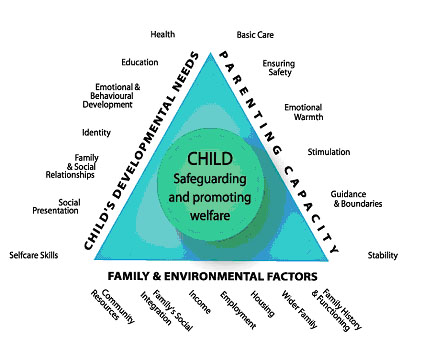
The Framework for the Assessment of Children in Need and their Families (also referred to as the "Assessment Framework") was developed by the Department of Education and provides detailed guidance for gathering and analysing information about all children and their families under three main dimensions; (1) the child’s developmental needs (2) the parenting capacity of those caring for the child and (3) the family and environmental factors around the child.
The dimensions are shown in more detail in the diagram below:
All assessments will include:
- An assessment plan, which sets out the focus and approach of the assessment, is developed and recorded by the Manager;
- Reviews on days 5, 15 and 30 from referral – this should be recorded by the manager;
- Seeing and talking to the child- this will include seeing and speaking to the child, alone, without their parents/carers being present and usually in a range of settings;
- Speaking to the parent(s)/ carers and other important and relevant family members- including those who live in a different household to that of the child;
- Consult with and seek information and contributions from all relevant professionals and agencies, who are supporting the child and their family – this may include agencies from previous addresses in the UK and abroad;
- Consult with agencies that may offer support for the family in line with current areas of need;
- Ensure that parent(s)/carers understand any concerns identified through the referral or assessment, as is safe and appropriate to share.
In rare circumstances, the Lead Practitioner and Manager may decide that a child should not be seen as part of an assessment- in these circumstances this decision and an explanation of the circumstances leading to it, will be recorded on the electronic record of the child.
The assessment will include information from a range of sources (including existing records and updating/ new information) so to understand the holistic needs of the child and their family. A clear account of family history, including patterns of help-seeking, helpful or unhelpful previous interventions, family dynamics, social graces, relationships, themes of harm/neglect and any disabilities or specialist needs. Practitioners should understand how racism, bias, cultural experiences and historic inequity may affect a child's or family's ability to engage and use this awareness to adopt anti-racist and anti-discriminatory practice that ensures families receive the support and services they are entitled to.
The assessment should adopt a whole family approach, considering how the needs of all household and key family members affect and influence the needs of the child (and vice versa). The assessment will consider systemic factors within the home, family and community, adopting a family-led approach wherever possible. The assessment will identify the best ways to work with the child and family, including disability or neurodiversity, cultural and heritage needs, communication requirements, literacy needs and personal preferences for engagement. Any assessments where the child also has caring responsibilities held by the child or young person, and the impact on their wellbeing and development.
Practitioners should build their understanding of the child's experiences across multiple visits and over time, recognising that children may present differently depending on the environment, the people present, and recent or historical events. Gathering information from across settings and moments allows patterns, changes and contrasts to be identified, ensuring the assessment reflects the child's actual day-to-day experiences rather than a single interaction.
The assessment must utilise tools such as a chronology and genogram to understand the holistic presentation and needs of the child. This helps us understand key events, patterns over time, changes in care, repeated concerns, and how previous interventions have influenced the child and family. Chronologies should support the identification of both cumulative harm and cumulative strengths. This is particularly important when assessing Neglect, Coercive Control and Domestic Abuse and Child Sexual Abuse (including hidden or intra-familial) and other forms of exploitation, including criminal and online harms.
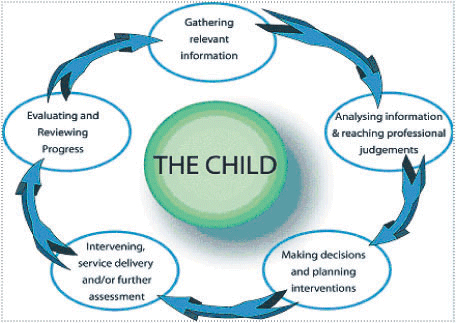
The assessment process can be summarised as follows:
- Gathering relevant information across all dimensions of the Assessment Triangle;
- Analysing the information and reaching professional judgments;
- Making decisions and planning interventions;
- Intervening, service delivery and/or further assessment;
- Evaluating and reviewing progress.
Whilst the written assessment is completed in line with this guidance and timescales, it is important to acknowledge that 'assessment' also refers to the ongoing understanding and consideration of the needs of a child and their family. As such the process of assessment is ongoing and cyclical, meaning that the Lead Practitioner, in every interaction and intervention with a family, should be considering the needs of the whole family and how support must adapt, change and evolve, in line with the changing needs of the child.
For assessments of children, pre-birth, additional guidance and actions are available. These follow the best practice guidance, taking into account the High Court judgment (Nottingham City Council v LW & Ors [2016] EWHC 11(Fam) (19 February 2016)) in which the Judge set out five points of basic and fundamental good practice steps with respect to public law proceedings regarding pre-birth and newly born children and particularly where Children's Services are aware at a relatively early stage of the pregnancy. For all assessments completed pre-birth, these five aspects must be included. They are:
- A risk assessment of the parent(s) should 'commence immediately upon the Lead Practitioner being made aware of the mother's pregnancy';
- Any Assessment should be completed at least 4 weeks before the mother's expected delivery date;
- The Assessment should be updated to take into account relevant events pre- and post-delivery where these events could affect an initial conclusion in respect of risk and care planning of the child;
- The Assessment should be disclosed upon initial completion to the parents and, if instructed, to their solicitor to give them the opportunity to challenge the Care Plan and risk assessment.
For all children, the assessment must be informed by their views, as well as the views of their parents/carers and other significant people within their network, such as wider family, friends and professional networks. This is achieved through direct work with the child which considers their age, developmental stage and identity. This direct work should usually include observation of the child in the care of their parent(s)/ carers as well as discussion and tools to understand their lived experiences, views and wishes.
For children with specific communication needs and/or in circumstances whereby a child may feel unable to share their experience and views verbally, consideration must be given to how the child could be supported to engage- this may include alternative communication approaches and the consideration of an advocate.
When a child is unable to share their experiences and views (such as pre-verbal children), the assessment must include a formulation of their needs and views using tools such as observation of behaviour or body language.
Fundamentally the assessment must seek to understand the child's whole life and experiences, not solely the concerns that prompted the referral. This includes forming a picture of how the child feels, behaves and functions across time, in different settings such as home, school and the community, and when spending time with different family members and significant adults. Understanding the child's experiences in their relationships, routines and daily life allows practitioners to form a fuller and more authentic account of the child's lived world. This is important as Practitioners must recognise that children may be experiencing multiple sources of strength and simultaneous harms (for example exploitation, online harm, domestic abuse or hidden CSA), and assessments must reflect this complexity.
Practitioners should also be mindful that some children receive assessments because there are concerns about their behaviours towards other children or adults - for example, parent-to-child violence, harmful behaviour within peer, teenage relationship abuse, or instances where a child is being exploited to harm or exploit others through physical, sexual or emotional abuse. It is essential that these behaviours are understood within a safeguarding framework. Even when a child is alleged to have caused harm, or is involved in the criminal justice system, they must not be viewed solely through a forensic or punitive lens; they remain a child in need of help, protection and support. Practitioners must therefore ensure that assessments explore both the harm caused and the child's own experiences of trauma, vulnerability, exploitation or unmet need, recognising that children who harm others are often themselves at risk.
All agencies involved with the child, the parents and the wider family have a duty to collaborate and share information to safeguard and promote the welfare of the child.
Any assessment should consider the impact of information, circumstances and findings on the care, safety and welfare of the child and inform onward decision making, as demonstrated in the diagram below.
The Child and Family Assessment should be centrally focused on the child's needs and improving outcomes in partnership with their parents/carers.
All assessments should be planned by the Manager and coordinated by the Lead Practitioner, supported by the Manager. At the start of each assessment an assessment plan will be drafted by the Manager which sets out the minimum enquiries required and the initial visiting timescale, based on the information contained within the referral.
The Assessment Plan will clearly record when, where, how and why we complete an assessment, including any reasons for why the assessment is being completed (i.e. a new referral or update following a significant event) received, including the desired outcomes identified by the referrer, the child and their family. The assessment must set out what we hope to achieve and the reasons this assessment is required, including any safeguarding or wellbeing issues.
The timing of the assessment should be proportionate to their presenting needs. The completion of any supplementary or specialist assessment or tools should also be completed promptly.
The initial visit will not exceed 5 working days and will often be completed before then.
A referral may focus on a specific child or the whole sibling group. In circumstances where the initial referral is in relation to one child in the sibling group (often known as the index child), the needs and impact of any other children within the home or sibling group should be equally considered using a whole family approach. This means that each child will have their own child and family assessment, proportional to their needs.
Questions to be considered in planning assessments include:
- What are the reasons for undertaking this assessment, including when, where, how and why the referral was received, the desired outcomes, and what we hope to achieve for the child and family?
- Who will undertake the assessment and what resources will be required in doing so?
- Who in the family will be included and how they will be involved, including absent or wider family members and others significant to the child?
- What is known about the family history, including previous interventions, patterns or themes, family dynamics, harm or neglect, and any disabilities or specialist needs?
- When and where the child should be seen, and whether they should be seen alone?
- What tools will be used to gather and analyse information?
- What systemic factors within the home, family and community need to be considered, and how a family-led approach will be adopted?
- What services are to be provided during the assessment?
- How Family Group Decision Making will be incorporated, and how the family's own plan - including any Family Safety Plan - will shape the assessment?
- How best to work with the child, parents and wider family, including disability or neurodiversity, cultural or heritage needs, language or communication support, literacy, personality and individual preferences for engagement?
- Whether there are communication needs, whether the child or parent requires an advocate, who within their safe network may appropriately provide advocacy, and whether an interpreter is required?
- How the assessment will consider the particular issues faced by black and global majority children and families, disabled children and families, and other factors arising from diversity?
- What method of collecting information will be used and how information will be recorded?
- The context of the presenting concerns within the social care history;
- What other sources of knowledge about the child and family are available (including housing), and how other agencies and professionals will be informed and involved?
- What is the Parent or Carers' capability and capacity to meet the child's needs, taking into account their own needs as an adult, such as Learning Difficulty, Parental Adversity, Mental health or Substance Misuse issues?
- What is the Parent or Carers Capacity to change or adapt their parenting ability to meet the child's needs including considering previous social care intervention?
- What formulation will be used to develop the analysis, and who will be involved in this process?
- How and when the conclusions and recommendations will be discussed and shared, including onward planning?
- What the child's educational needs are, including attendance, attainment, wellbeing in school, access, SEND needs or EHCP requirements?
- Whether the child or young person has caring responsibilities, and the impact of these responsibilities on their wellbeing and development?
In relation to unborn babies the Central Bedfordshire Pre-Birth Assessment and Guidance must be followed.
The role of analysis in assessment is to draw together key themes and offer the practitioner's interpretation of the child's circumstances and those of their family, based on all information gathered. This section should not simply summarise or repeat earlier content but instead bring focus to the primary areas of strength, risk and support, and clearly describe the impact of these themes on the child's lived experience.
The analysis should explore the interactional cycles within the family, including how family members influence one another's behaviour, the roles and expectations that have developed over time, and how these patterns affect the child's lived experience. The analysis should also consider patterns in professional involvement, such as repeated referrals, gaps in support or interventions that have previously been effective or ineffective. Chronology and pattern analysis should highlight cumulative factors-such as poverty, housing instability, trauma history, health needs, discrimination or exclusion-that may increase stress or reduce the family's capacity for change.
Using a formulation-based approach, the practitioner should identify what is helping or hindering progress, drawing together relational, emotional, practical and structural factors across the family and professional network. This analysis should directly inform clear recommendations for any onward support. While the written assessment is completed by the lead practitioner, it must reflect genuine partnership work with the child, family and wider professionals.
Assessments must be written clearly to the child and family, outlining what needs to change or remain consistent to promote the child's safety and wellbeing and forming the basis of a clear plan. Crucially, where needs for support are identified, these must be acted on immediately-support should not wait until the full assessment is completed.
It is important that we help children, but supporting whole families and their networks, working in partnership with parents and carers to address difficulties that families face.
In part, this partnership is achieved through discussion and a shared understanding of consent.
Consent for assessment, support and information sharing will be sought by the Integrated Front Door and can be withdrawn by the parent(s) or carers at any stage. Children are able to request their own assessment, and there may be times when the views or additional information from their parents are required - for example, a child who is 16 or 17 years old.
All personal information about children and families held by professionals is subject to a legal duty of confidence and should not normally be disclosed without the consent of the subject.
Whilst assessment, support and enquiries will usually always be completed in partnership with the family, and based on consent, Children's Services have specific responsibilities, with our local safeguarding partners, to make necessary enquiries when significant harm to a child(ren) is suspected. This may include consent being overridden, if necessary and proportionate to the suspected risk, so as to enable swift action to keep the child(ren) safe.
There will be occasions when a parent or young person does not engage, or when attempts to engage them in an assessment are unsuccessful. In these situations, practitioners should continue to adopt a relational and non-judgemental approach, drawing upon trauma-informed principles. Using Motivational Interviewing (MI), practitioners should adapt their communication style to meet the needs, preferences and experiences of the parent or young person. This includes being curious about what might support engagement, recognising how trauma, discrimination, previous experiences of services and power dynamics may shape responses, and ensuring communication feels safe, respectful and non-judgemental.
There will also be occasions when a family, parent, or young person declines, withdraws, or finds it difficult to engage in an assessment. This should not automatically be interpreted as deliberate avoidance, deception, or risk escalation. Many families have experienced services that felt overwhelming, discriminatory, or harmful, and some may have experienced trauma that affects how they interact with professionals. Equally, some families may simply exercise their right not to take part.
In all circumstances, practitioners should adopt a stance of curiosity, compassion, safe uncertainty, and non-judgement. Safe uncertainty involves being open to multiple possible explanations for a family's behaviour and resisting premature conclusions about intent or risk. This stance supports practitioners to remain balanced recognising that most difficulties in engagement arise from understandable factors, while also acknowledging the small minority of situations where avoidance may relate to escalating risk.
Using approaches such as MI, practitioners should explore the family's perspective and consider how language, systems, previous interventions and power dynamics may impact engagement. A lack of engagement should therefore be understood within the wider context of lived experience- including trauma, fear, mistrust, communication needs, cultural experiences, and previous encounters with professionals.
When engagement remains limited despite these efforts:
- A risk assessment should be completed on all the known information within the Child and Family Assessment document;
- Consider whether the child has the capacity to refuse assessment;
- Consider whether the child may be at risk of significant harm, and therefore whether a strategy meeting is required under Section 47 Children Act 1989;
- Consider whether legal advice is required.
In circumstances where a family move to another local authority or withdraws their cooperation, the Manager may consider that the Child and Family Assessment should still be completed. In such circumstances, the manager must record this decision together with the reasons the assessment has continued, and ensure the decisions are shared with the parents, child and other agencies involved.
Where an enquiry under Section 47 is being conducted as part of the Child and Family Assessment and the parents or child withdraw their cooperation or move away, the Child and Family Assessment cannot be considered to have been completed unless the Manager is satisfied that arrangements are in place to safeguard the child concerned.
The response may include:
- A further Strategy Discussion/Meeting;
- Seeking legal advice about the need for an Emergency Protection Order or Child Assessment Order;
- Negotiation with the local authority into whose area the family has moved.
The completed assessment and details of the referral would be shared with the Local Authority to which the family have moved, as well as a recommendation of the support the family needs, to enable onward support as required.
An updated Assessment should normally be completed when:
- An enquiry under Section 47 of the Children Act 1989 is undertaken;
- There is a significant event, or indication of change in the needs for the child;
- There is a change in threshold determination (i.e. between targeted early help to a child in need).
For Targeted Early Help:
- At least every 12 x months;
- When there are clear indicators of significant change.
For Children in Need, an updated assessment should be completed:
- At least every 12 x months;
- When there are clear indicators of significant change;
- For children with a disability, assessments are reviewed prior to a short break episode, every 12 months and where there are significant changes in the nature of the identified disability.
For children subject to a Child Protection Plan, an updated assessment should be completed:
- In advance of any Review Child Protection Conference (within the core group formation);
- After 9 months of being subject to a Child Protection Plan;
- When there are clear indicators of significant change.
For Children who are Looked After, an updated assessment should be completed:
- In preparation for every Looked After Child Review;
- Where there are significant changes e.g. a child coming into care or leaving care before the age of 18. A child moving placement or changes to a child's care arrangements such as family moves or changes in the adults in the household.
The purpose of updating an assessment is to consider the changing needs/risks related to the child/young person and to begin to formulate plans to meet those needs and manage identified risks.
The Lead Practitioner must review where changes are apparent. Independent Reviewing Officers and Child Protection Chairs must oversee and offer guidance as appropriate, when changes merit assessment review and what the potential recommendations may be.
Please read in conjunction with Recording Policy and Guidelines.
The overarching principles for recording of all interventions and contact with children and their families are
- Records must be kept for all children with whom Children and Families Services have/make contact;
- Children and their families should know what type of information is recorded and know how they can access this;
- The practitioner leading any intervention is responsible for recording this – this will usually be the Lead Practitioner;
- Records must be written clearly and for the child;
- A record of any intervention or visit should usually be recorded within 24 hours, and in any event not exceeding 48 hours.
When completing the Child and Family Assessment, the wishes and views of the child and their parents, carers and other significant family members and professionals should be recorded within the assessment and will support the formulation of the practitioner's analysis of the support the family needs.
Assessments should be written in a way that children can understand both now and, in the future, enabling them to make sense of decisions that have affected their lives. While it is sometimes appropriate, such as for children who are looked after, to write parts of the assessment directly to the child, practitioners should remain mindful that research indicates this approach may unintentionally minimise risk or mean we are not clear with what needs to change for the child's life to improve. For this reason, the assessment includes a dedicated child-friendly summary section to explain what is happening to the child, while the main assessment must retain a clear, accurate professional analysis of risk, need and concern.
Upon completion of the assessment, this will be shared with the parents/carers in written form within 5 working days. Any response to views regarding the assessment should be clearly recorded in the child's electronic record.
When a child aged 16 or 17 years old seeks help from, or is referred to the Local Authority, because they are, or at risk of being homeless, an assessment must be completed to determine their needs, and any duty of care owed to them. This assessment will be completed by the Lead Practitioner and will usually be completed jointly with the Homelessness and Mediation Services Coordinator.
For the avoidance of doubt, this includes 17-year-olds who are approaching their 18th birthday, and young people who are pregnant or have children in their care.
If there is an imminent threat of homelessness, or if the young person is actually homeless, arrangements for immediate provision of help and support should be explored- this may include accommodation under Section 20 Children Act 1989, where this is aligned with the wishes of the child. In these circumstances the young person must be offered an advocate and be provided with clear advice (including a written copy) of their rights under Section 20.
The support offered should be provided immediately and alongside the assessment, and must not wait until the conclusion of the assessment, albeit an initial formation of risk and need should inform and support decisions around immediate support and provision of services (including when accommodation is provided under Section 20).
Increasingly, supporting children now also involves support in circumstances when key family members live outside of the UK, necessitating assessments of family members in other countries.
Guidance and learning from the Court of Appeal identifies that it might not be professional, permissible or lawful for a social worker to undertake an assessment in another jurisdiction. Children and Families Across Borders (CFAB) advise that enquiries should be made as to whether the assessment can be undertaken by the authorities in the overseas jurisdiction. As such, social workers based in the UK should not routinely travel overseas to undertake assessments in countries where they have no knowledge of legislative frameworks, cultural expectations, or resources available to a child placed there.
When the need for assessment of family members, outside of the UK, occurs- this will be discussed and considered based on individual circumstances.
Determination of the need for an assessment in circumstances whereby the family has no recourse to public funds is based on the same formation, criteria and duty as set out in chapter 1. An assessment would not be completed based solely on the identification of a family having no recourse to public funds, but rather when the lack of recourse impacts the care or welfare of the child.
Additional considerations to be made both for pre-assessment screening and during the assessment are set out in Families with No Recourse to Public Funds.
This section should be read in conjunction with the Local Safeguarding Board procedures, Working Together to Safeguard Children.
The principles which underpin any enquiry under Section 47 of the Children Act 1989 are:
- The safety of the child is paramount;
- The wishes feeling of the child must always inform the enquiry;
- The views of parents are heard and included, including parents/ carers who live outside of the child’s household;
- How, together, the family network can support the child and household, must form part of all safety planning;
- Whilst the enquiry would usually be led by Social Care and /or jointly between Social Care and Police - all agencies working with / or with knowledge of the family have a role in developing a shared understanding of the risk of harm and working together, in partnership with the family, to ensure the child is safe;
- The outcome and decision-making must be shared clearly and in a format which is accessible to the family by the appropriate professional for the family.
|
Decisions arising from a strategy meeting |
The strategy meeting must be attended by all agencies working with the child and their family. If an agency cannot attend, they should usually send/ share information about their role with the family in advance of the meeting. The strategy meeting will determine if an enquiry under section 47 is required. All agencies should contribute to this decision-making and safety planning. In the event that agencies are not unanimously agreed as to whether an enquiry under section 47 of the Children Act 1989, dissenting views must be recorded, and the decision will be taken by the Team Manager (social work qualified). All strategy meetings, regardless of outcome (section 47 or section 17), must include a safety plan which has been developed and is owned by all agencies directly working with the child and their family. |
|
Referrals which indicate a non-accidental or un- unexplained injury to a child |
The Head of Service and Service Manager should be notified immediately. An urgent referral should be made for a Legal Planning meeting, and/or a legal representative should be invited to attend the strategy meeting. This should usually be done with consent from the Head of Service. Examples of this may include:
|
|
Seeing and Engaging Children |
The child must always be seen and communicated with alone in the course of a Section 47 Enquiry by the Lead Social Worker, unless it is contrary to his or her interests to do so. The Strategy Discussion/Meeting will plan any interview with the child. The Record of Section 47 Enquiry and Reports to Child Protection Conferences should include the date(s) when the child was seen alone by the Lead Social Worker and, if not seen alone, who was present and the reasons for their presence. All enquiries would usually be made in partnership with the family, including discussion of the identified risk; however, in some circumstances, the risk of significant harm is such that information may be withheld whilst immediate safety planning and enquiries are undertaken, with full details being shared thereafter. |
The enquiry will continually consider and review the needs of the child to inform the written outcome record. This written outcome will capture all interventions and information from within the enquiry period to formulate an analysis of the suspected risk of significant harm. Through this, the enquiry will determine:
-
The risk to the child is ongoing and further safety measures are required;
-
The risk to the child has reduced and the child is no longer at risk of significant harm because of the interventions and or safety planning developed;
-
The concerns were not substantiated and there is no ongoing risk of significant harm to the child.
|
The risk to the child is ongoing, and further safety measures are required. |
An Initial Child Protection Conference must be convened within 15 working days of the Strategy Discussion/Meeting where the decision to initiate a Section 47 Enquiry was made. The request to convene the conference must be supported by a team manager. For the detailed procedure in relation to Child Protection Conferences, see Central Bedfordshire Safeguarding Children Partnership Multi-Agency Safeguarding Arrangements. The safety planning for the children must continue to be reviewed and updated in line with the changing presentation of risk and need. Where immediate protective action is required, the advice of Legal Services should be sought. |
|
The risk to the child has reduced, and the child is no longer at risk of significant harm because of the interventions and or safety planning developed. |
The child and their family would continue to access support from their lead practitioner and network, from the locality in which the family live. A child and family assessment will be completed, and provision of any support as required, at the point of identification, will be provided. As part of the assessment of support, a child in need meeting would usually be held to bring together the child, family, and their professional network to discuss and consider the support the family needs. The safety plan would continue to be regularly reviewed and updated in partnership with the family. |
|
The concerns were not substantiated, and there is no ongoing risk of significant harm to the child. |
The child and their family would continue to access support from their lead practitioner and network, from the locality in which the family live. An assessment of need would usually still be completed; this will be led by the most appropriate practitioner for the family and may, for some children, focus on targeted early intervention/ help. The lead practitioner should be determined based on the child’s needs and who is most suitable to support the family. |
Last Updated: April 2, 2026
v183


You can translate the content of this page by selecting a language in the select box.
Copyright © tri.x